About
What We Do
Let’s build a better world, together, starting right here, in Australia.
Our Mission
We believe that charity begins at home and by harnessing the power of youth and families through community service, we can build a kinder and more connected world.
Our Vision
Australia evolves from the lucky country to the loving country.

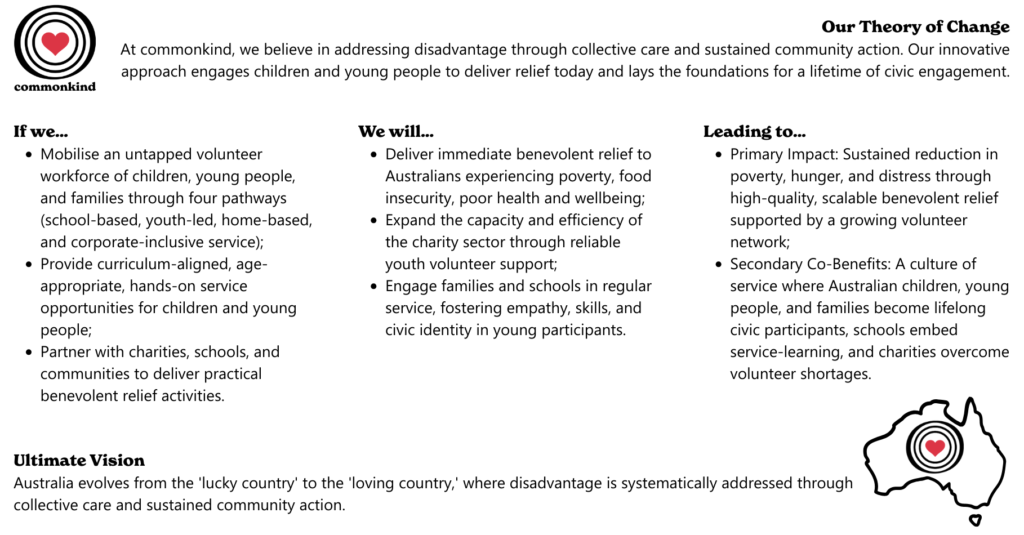
Our Theory of Change
At commonkind, we believe in addressing disadvantage through collective care and sustained community action. Our innovative approach engages children and young people to deliver relief today and lays the foundations for a lifetime of civic engagement.
If we…
- Mobilise an untapped volunteer workforce of children, young people, and families through four pathways (school-based, youth-led, home-based, and corporate-inclusive service);
- Provide curriculum-aligned, age-appropriate, hands-on service opportunities for children and young people;
- Partner with charities, schools, and communities to deliver practical benevolent relief activities.
We will…
- Deliver immediate benevolent relief to Australians experiencing poverty, food insecurity, homelessness, and social isolation;
- Expand the capacity and efficiency of the charity sector through reliable youth volunteer support;
- Engage families and schools in regular service, fostering empathy, skills, and civic identity in young participants.
Leading to…
- Primary Impact: Sustained reduction in poverty, hunger, and distress through high-quality, scalable benevolent relief supported by a growing volunteer network;
- Secondary Co-Benefits: A culture of service where Australian children, young people, and families become lifelong civic participants, schools embed service-learning, and charities overcome volunteer shortages;
- Ultimate Vision: Australia evolves from the ‘lucky country’ to the ‘loving country,’ where disadvantage is systematically addressed through collective care and sustained community action.
Our Values
We strive to GIVE:
G
I
V
E
Generous – we give what we can freely
Inclusive – we welcome everyone to participate
Valuable – we seek to create value for our stakeholders and we value others
Enterprising – we embrace innovation and seek new ways to make an impact

Why do we do it?
Compared to many places in the world, Australia has got it relatively good but even so, there are ways we can make our society more just and equitable.
Australia Today
Did you know that in Australia:
Sustainable Development Goals Commitment
commonkind is committed to the United Nations’ 17 Sustainable Development Goals (SDGs) for peace and prosperity for people and the planet. Read up on the goals here.
We use community service to work towards these goals. We strongly believe that dismissing the help that children and their families can provide to the charity sector is a big mistake, especially given the documented decline in adult volunteering in Australia.4 The United Nations agrees that volunteering is a critical enabler to achieve the SDGs and states:
“This much is clear: drawing upon the incredible creativity, energy and expertise of volunteers will be crucial to shaping a greener, more inclusive and more sustainable future.”United Nations Volunteers (UNV) programme. (2021, December). 2022 State Of The World’s Volunteerism Report: Building Equal And Inclusive Societies.
Our programs are focused on providing benevolent relief to people and communities suffering from poverty, disadvantage and distress aligned with the following SDGs:


References
- Davidson, P; Bradbury, B; and Wong, M (2022) Poverty in Australia 2022: A snapshot. Australian Council of Social Service (ACOSS) and UNSW Sydney. ↩︎
- Miller, K and Li, E. (2022, October) Foodbank Hunger Report 2022. Big Village (Big Village Reference AU3000928) ↩︎
- Australian Institute of Health and Welfare 2013. Depression in residential aged care 2008–2012. Aged care statistics series No. 39. Cat. no. AGE 73. Canberra: AIHW. ↩︎
- Biddle, N., Boyer, C., Gray, M., & Jahromi, M. (2022) Volunteering in Australia: The Volunteer Perspective. Volunteering Australia, https://volunteeringstrategy.org.au/wpcontent/uploads/2022/10/Volunteering-in-Australia-2022-The-Volunteer-Perspective.pdf ↩︎


